I wanted to compare images taken of Jupiter with a modern refractor and the Northumberland telescope. The Northumberland was built in the 1830’s but has been upgraded since then and is famous for almost discovering the planet Neptune.
Read about it here https://www.ast.cam.ac.uk/about/northumberland.telescope
I personally own and use a SkyWatcher Esprit 120ED APO refractor. Since this refractor works at F7 (focal length 840mm and diameter 120mm) I use a x2.5 Televue barlow to increase the F number to 17.5 thereby giving me a larger image. I also use an IR cut filter to prevent my CCD camera from being swamped by the longer wavelengths.
The camera is a ZWO 294MC Pro one-shot colour camera and I use ZWO’s ASICap to capture video images of Jupiter. I ran videos of 60 seconds in length. At opposition this would mean that Jupiter’s mid-position could have moved by about 0.25” (arc seconds) due to it’s axial rotation in this time period. The Dawes’ limit of my scope is about 1” (arc second) under perfect conditions and that of the Northumberland telescope is slightly better than 0.5” (arc seconds). The blurring due to the exposure time is small. There is software (WinJUPOS) that can be used to deal with this but it was not used in this comparison. On two separate occasions (both estimated at Bortle 4 by FLO Clear Outside App), I took videos using my ZWO 294MC Pro camera and IR cut filter. The Televue x2.5 barlow was used with the 120mm refractor (F17.5) but not when done with the Northumberland telescope (F20).
Focusing with the 120mm refractor was done by focusing on a star first and producing a ‘V’ curve to attain precise focus. Videos (16 in all) were then taken of Jupiter and processed using the following software:
- Pipp – debayer, c rop and centre
- AutoStakkert! – analyse, select best 50% of images and stack
- Registax – wavelet enhance and adjust colour balance
The same method, except focusing , was carried out using the Northumberland telescope. Since the Northumberland doesn’t have electronic focusing control, I could only estimate the best focus position by eye. Four sets of 3 videos were taken with 4 different estimates of the best focus position. This is the best image I got from the 120mm refractor:
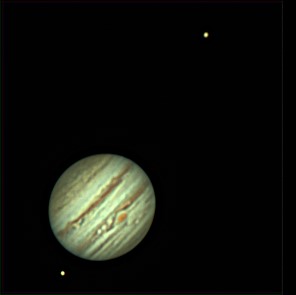
Io is about to transit and is the moon shown in the bottom left.
Compare this with the best Northumberland image:

I think it is clear that the 120mm refractor image is considerably clearer and more detailed. I find it hard to believe that I was significantly out on my manual focus in all of the videos when using the Northumberland. I am wondering is there something wrong with the collimation of the Northumberland – or some other cause for the marked difference in these results? I got similar results last year when Jupiter came to opposition and the Northumberland gave similarly disappointing results.
The following is a short gif created from 16 videos of Jupiter (giving 16 frames for the gif) showing Io commencing its transit.
