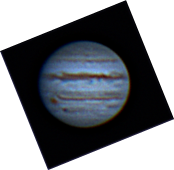
Jupiter – 21 March 2026
Although Jupiter is now over 2 months past opposition, I wanted to use my Esprit with a more powerful Televue barlow lens. Up until now I’ve only used my x2.5 Televue. I had previously tried the x5 Televue and the results were not impressive, but, this could have been a one off due to poor seeing or poor focus. At x5 the focal ratio of the Esprit becomes F35.
The following images were done with my SkyWatcher Esprit 120ED APO and x5 Tele Vue barlow (F35). The seeing deteriorated during the session. The video below was constructed using AS4 and WaveSharp with 90 x 45s videos captured with SharpCap and a ZWO294MC Pro OSC and L-Pro IR cut filter. The session starts with relative good seeing at 20:41GMT, deteriorates in the middle of the session and the clarifies again. The moon seen moving in from the right is Europa and almost disappears as the seeing deteriorates and the re-appears again.
Conclusion
The x5 Tele Vue gave pleasing results despite Jupiter being 2 months past opposition and lower in the sky by the time the session could be started. I will definitely be using the x5 barlow more in future.
Jupiter – 22 February 2026
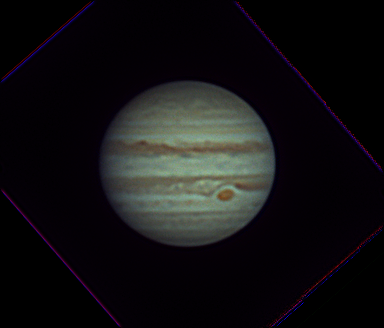

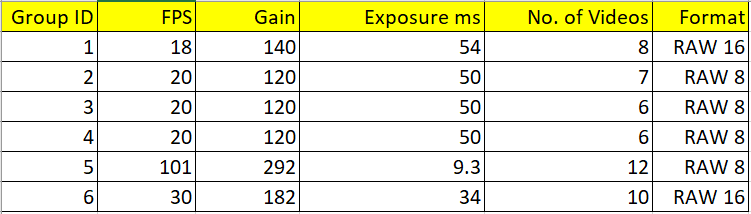
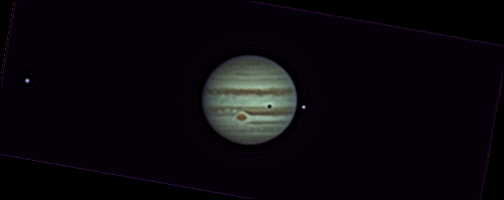
After many weeks of cloudy skies I got an opportunity on 22 February starting at 22:05 GMT when Io was just finishing a transit of Jupiter with a trailing shadow. Six batches of videos were taken between 22:05 and 22:53 at which point the shadow transit was almost ended. Each batch of videos was taken under different settings and has been numbered 1-6 in the table below. A sample image, processed from one of the videos in each group is also shown to allow for quality comparison.
Equipment: SkyWatcher Esprit 120ED Pro, 2.5 Televue (F17.5) and L-Pro IR cut filter.
Group 1 (the moon to the left of the image is Ganymede)

Group 2
Groups 3 & 4
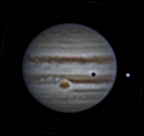
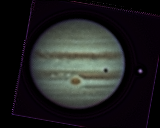
Groups 5 & 6
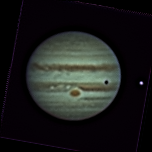
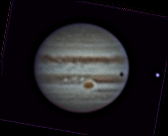
Finally, all 49 videos were processed and put together to produce the following animation:
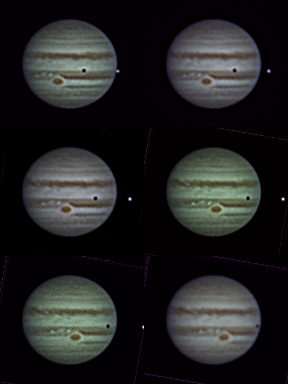
I cannot see much difference in the quality of the 6 sample images. Possibly the group 5 image may be marginally better. This was taken at a much higher gain and shorter exposure.
My Conclusion
There may be a small improvement in quality by pushing up the gain in order to achieve shorter exposures and faster frame rates thereby capitalising on the ‘lucky’ images when the atmosphere is momentarily steady. However, the extra noise introduced by the higher gain seems to offset any real advantage of the faster frame rate.
Jupiter – 2 January 2026
With Jupiter at opposition on 11 January, it’s a good time to try and capture some moon transits. The following short video does not show any transits but I wanted to try things out. Taken with my SW Esprit 120ED APO and x2.5 Televue (F17.5). I used AutoStakkert! 4 and WaveSharp 3 to process. Each frame was a 45s video and there were 21 frames. The psychedelic effects are an artefact created by WaveSharp 3 which I could crop out but, well, I think they look fun! The shots were taken between 22:53 and 23:11.

Jupiter – 15 December 2022 with Ganymede Transit
Jupiter came to opposition on 26 September 2022 – so it is now well past opposition. The following image was created using the Esprit 120ED APO and a x2.5 Televue barlow (giving F17.5 and focal length of 2100mm). Taken using ZWO ASI924MC Pro colour one-shot camera, 120s video with 8ms exposures yielding 13814 frames (approx 115 frames per second). Camera at -1.2C – I forgot to turn on the cooler! Capture area size only 320×240 which allowed the high frame rate.
Debayered using Pipp, Stacked in AutoStakkert! and wavelet sharpened in Registax 6. In AutoStakkert! I found the best image was using only the top 5% of the frames, manual selection of alignment points and turn the noise robust level down to the lowest setting (2).