M31 – Andromeda up close

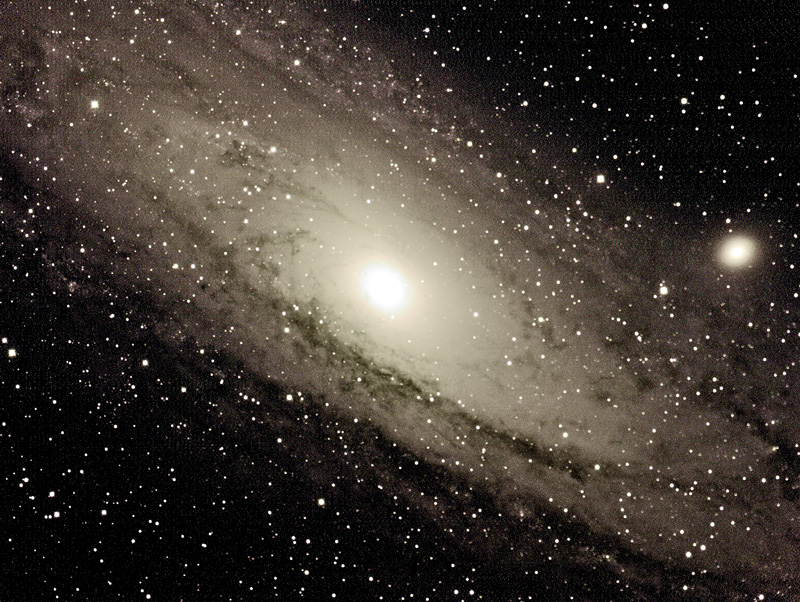
I am still not happy with the auto-guider accuracy, the graph showing anything up to 1 pixel plus or minus. This improved by making sure the RA axis was pulling against gravity but my next step is to recheck the polar alignment. I should be able to get to within +/- 20% of a pixel IMHO. Anyway, here is a low res image of M31 of 8 luminance subs at 240s and 1×1 binning and 5x60s RGB subs at 2×2 binning. Images were calibrated in Maxim DL, scaled in Fits Liberator using ArcSinh(x) function. Photoshop zone processing was done using curves and levels and the luminance frame then had a high pass filter applied. Finally, the LRGB frames where combined in Photoshop.

This picture really needs a focal reducer to capture more of the (rather large) Andromeda Galaxy.
M31
M31

Posted in Uncategorized | Leave a comment

Saturn – A Comparison of Stacked Images

Camera: DMK 21AU04.AS Monochrome USB astronomy camera (1/4 ” CCD, Sony ICX098BL) resolution 640 x 480 pixels.
Filter: Astronomik Pro Planet 742nm IR pass
Telescope: Orion Optics AG12 300mm F3.8
Software: Registax 6

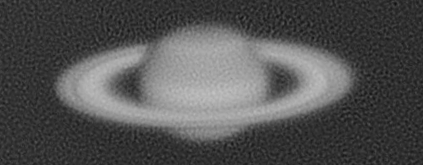
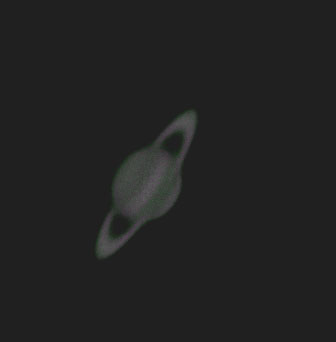
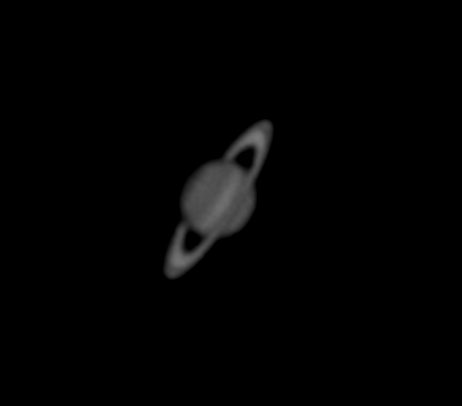
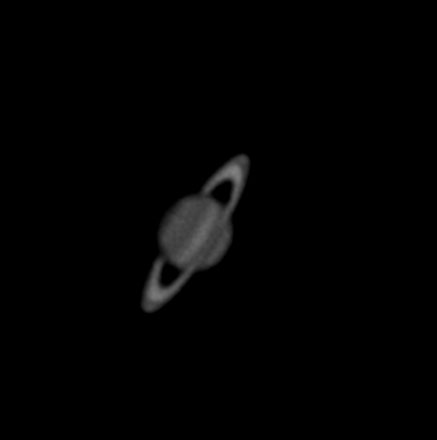
The two small images were with a x2 barlow lens and the larger image with a Televue x5 barlow. The latter provides a larger (but fainter image) resulting in a longer exposure time of 1/15 second – image quality is lost in this image. A larger number of stack  images seems to provide a better end result.

Saturn_S1_x2IRPass_4000Stack130606

Saturn 4000 stack 6 June 2013 (x2 barlow)


S1-FullGain-IRPassx2Barlow15thSec_2400Stack130607

Saturn 2400 stack 7 June 2013 (x2 barlow)


S3-FullGain-IRPassx5Barlow15thSec-2400Stack-130607

Saturn 2400 stack 7 June 2013 (x5 barlow)

Posted in Uncategorized | 1 Comment

M101

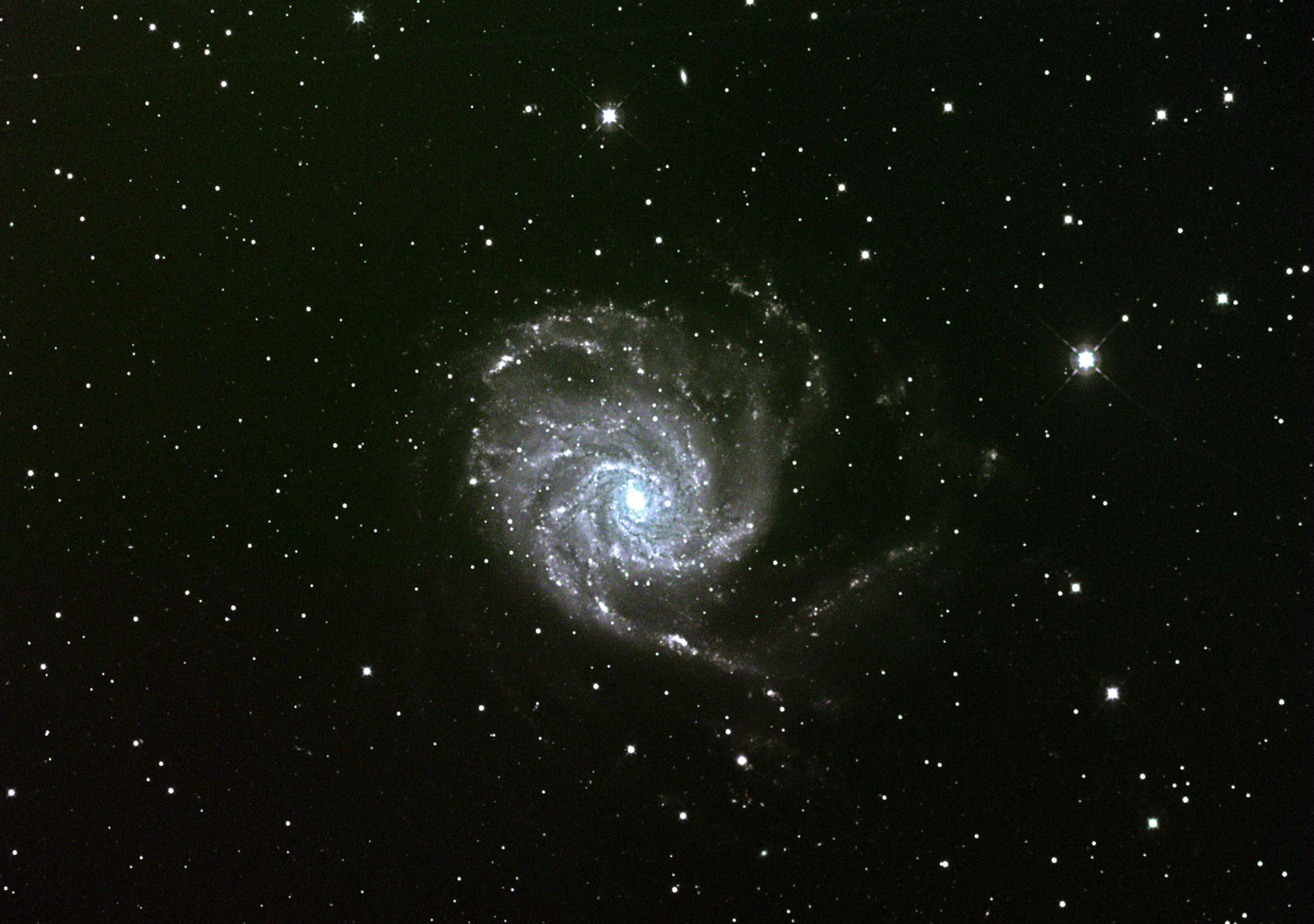
Having visited Astrofest I spoke to my good friends at Orion Optics who kindly offered to re-silver and service my VX14 as part of a purchase of an Advanced Astrograph 12 (AG12). The AG12 has a carbon fibre tube and a corrected field flattener based on the Wynne Corrector giving a very flat field view. Coupled with my QSI 683 I have taken the opportunity to photograph M101, a spiral galaxy about 21 million light years away in the constellation of Ursa Major.

M101

The image above consists of 10 luminance subs at 960s and 1×1 binning combined with 5 red subs at only 60s and 2×2 binning and the same for green and blue. Bias, darks and flats were used to calibrate the subframes in Maxim DL (software that I would highly recommend). The final LRGB masters where then processed in photoshop using a high pass filter and then finally combined into the colour image.

Posted in AstroPhotos, Uncategorized | Leave a comment

B33 Horse Head Nebula

Here’s an image with my new QSI683 camera. I didn’t take any dark frames on this occasion. Luminance and red layers are H alpha, there are also blue and green layers. This image was processed in Maxim DL.

Horse Head Nebula

Here’s the same image, again, the  master frames processed in Maxim DL, but the layers combined in Photoshop.

Posted in AstroPhotos | Tagged | 2 Comments

M13 and IC4617 11 May 2012

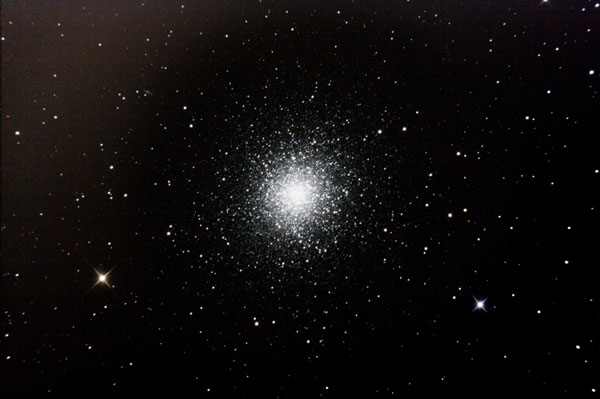
Having drift aligned the Titan mount for about an hour or so I tried a 45 second no guidance exposure on M13 with the Canon 450D. The picture below consists of 16 x 45sec exposures at ISO 1600.

M13 and IC4617 (magnitude 16 galaxy)

Not sure why I got some light pollution in the top left of this picture. I took flats but no dark frames (must do that next time). Not bad for 45s. IC4617 can be seen between 10 and 11 o’clock in the picture about halfway out from M13 just to the right of a distictive parallelogram of stars. Whilst M13 is only 25,000 light years away from us, IC4617 is at a staggering 490 million light years distance.

Posted in AstroPhotos | Tagged , | 2 Comments

Saturn 29 April 2012

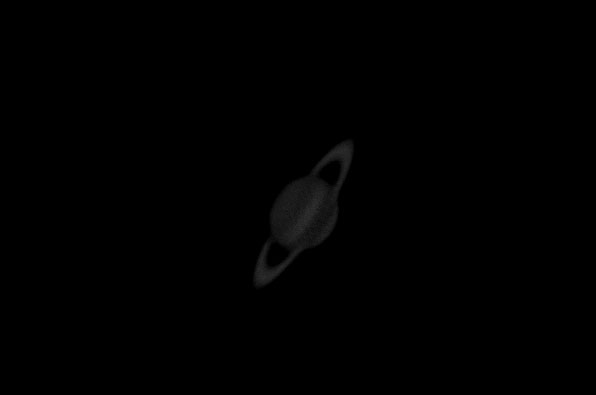
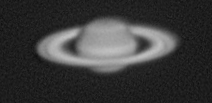
Since the 17th April we have had rain and more rain, and, as of 11 May, this was the only break in the weather. Seeing was average at best and I tried to get another shot of Saturn, this time with a barlow lens. Since the image was ‘boiling’ rather a lot, I think the mistake I made was to assume that a short exposure, albeit dim, would be superior to a longer exposure that might suffer from atmospheric distortion. The brighter ‘no filter’ images below seem to produce a slightly better result. Saturn is quite low and the light pollution from nearby Royston doesn’t help. Here is a composite RGB image taken with a x2 barlow through the VX14 (although the blue image was so faint I did cheat and use the green image again at 50% instead of the blue one – it does have a greenish tinge – oh well).

And then brightened a bit …

and then with no filter, so monochrome, but brighter …

 and slightly more processed …

This just underlines to me that the seeing conditions are, of course, paramount, and that getting a short exposure in the video images appears to be counter productive and does not out weigh any atmospheric losses incurred from a longer frame exposure time.

Posted in AstroPhotos | Tagged | Leave a comment

Saturn 17 April 2012

I took a number shots of Saturn (which was at opposition 2 days ago on 15 April). Its not very high in the sky so I took the shots around midnight to get the maximum altitude. The computer disc was filling up with large AVI files and, in my sleepy state, managed to accidentally delete the images I took with a x2 and x5 Barlow lens. So the image below is at prime focus and therefore somewhat small -but what’s the magnification? Magnification is really concerned with the angular view of the object when seen with the optical aid compared to the unaided view. A rough guide is to consider a 50mm lens produces a magnification of 1 when used with a camera (or ccd sensor). So at prime focus, a rough guide is the telescope focal length (mm) divided by 50 (mm). So for my VX14 with  its 1600mm focal length this is about 32 at prime focus. Saturn at about 20″ arc would cover approximately 1/30 of the width of my DMK21AU04.AS chip.

I am waiting for the next clear night so I can try this again with a x2 and x5 Barlow lens and this time I have plenty of disc space 🙂

Posted in AstroPhotos | Tagged | Leave a comment

Mars 27 March 2012

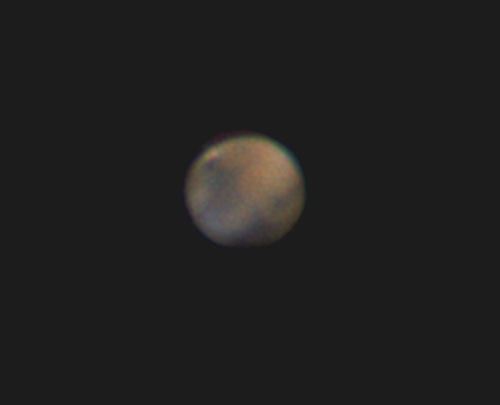
After re-installing the latest version of the DMK IC Capture software, the camera has thankfully settled down. This is my first attempt at Mars with RGB Astronomik filters and a DMK mono camera. I have a lot to learn!

I  know its not stunning but there’s big learning curve to get this far, so I am hoping I can improve on this. There were 3 x 60 sec video files (avi) at 60fps, so about 3600 frames each. Processed with registax 6 and wavelet enhancement. The resulting RGB images were aligned manually in Photoshop using the difference feature of adjacent layers and finally added to the RGB channels of the final image.

Orion Optics VX14, (f4.5 with x5 Televue Powermate = f22.5) and Losmandy Titan

I think the overall quality of the image is very dependent on the ‘seeing’ and the ‘seeing’ and definitely the ‘seeing’ – not to stress the ‘seeing’ quality too much of course 🙂

Mars 27Mar12

Mars

Posted in AstroPhotos | Tagged | Leave a comment